AI
Groq and StackAI push enterprise AI agents into tightly regulated sectors
Groq and StackAI claim enterprise AI agents are now being adopted in banking, hospitals, government, and law firms, with speed and trust as key factors.
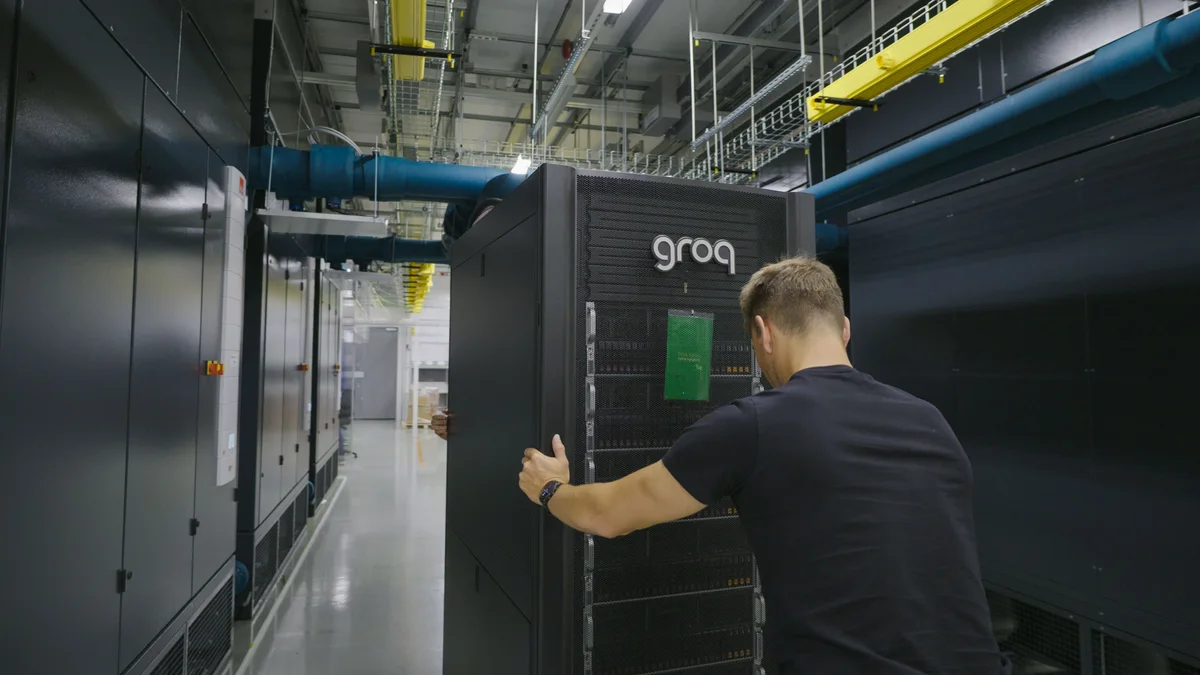
Groq, the neocloud company focused on fast inference, announced via its official X account (@GroqInc) on August 8, 2026, that enterprise AI agents are now being adopted in four highly regulated sectors: banking, hospitals, government, and law firms. This statement marks a significant shift from AI assistants (copilots) toward agentic systems that can act more autonomously in compliance heavy business environments. In the post, Groq emphasized that while computational speed remains important, trust is a more critical element when AI agents operate in sectors that handle sensitive data and high stakes decisions. Groq cited its collaboration with StackAI as an example of how secure, high performance AI agents can be built on Groq's infrastructure.
The announcement comes amid research reports showing accelerating adoption of AI agents at the enterprise level. Forbes reported on June 12, 2026, that enterprise AI is reaching an inflection point, with a shift from copilots to autonomous agentic systems, driven by data quality, governance, and interconnected platforms. Quantitative data from Gartner, summarized by informedclearly.com on May 27, 2026, reinforces this trend. Gartner predicts that 40 percent of enterprise applications will embed AI agents by 2026, up sharply from just 5 percent in 2025. This forecast places the market value of this shift at $450 billion, signaling that AI agent adoption is no longer a limited trial but a structural change in business operations.
A study from Okta released in 2026 highlights a striking gap between executives' confidence in AI agents and how employees actually use the technology. Okta notes that this gap creates a worrying security hole in companies, reinforcing Groq's argument that trust and security are prerequisites before AI agents can be relied upon in critical sectors. Boston Consulting Group (BCG), in its 2026 publication, emphasizes that to scale AI agents in regulated businesses, companies need a common enterprise platform that balances innovation with governance. This view aligns with the approach advocated by Groq and StackAI, where integrated infrastructure and controls form the foundation for building trustworthy agents. The Groq and StackAI partnership is not new.
In a case study published on Groq's official website on June 22, 2026, the two companies had already collaborated to empower customer service and enterprise support agents. In that case study, Groq described itself as the leading neocloud for fast inference, with a fully integrated platform covering infrastructure, inference, and controls. This claim is supported by operational scale, with millions of developers running trillions of tokens on Groq each week. The shift toward AI agents in tightly regulated sectors carries different technical implications compared to general AI adoption. In banking, AI agents could potentially handle compliance and fraud detection that require real time responses. In hospitals, agents could assist with insurance claims administration or patient data management under strict privacy standards.
In government and law firms, the need for clear audit trails and regulatory compliance becomes a top priority. The inference speed that is Groq's strength remains relevant in these scenarios, but trust encompasses broader aspects, such as data security, decision transparency, and auditability. This is what distinguishes AI agent adoption in high risk enterprise sectors from using AI for general tasks. Okta's report highlights that although executives have high confidence in the potential of AI agents, the way employees use the technology often does not align with management's assumptions. This misalignment creates serious security risks, especially when AI agents are given access to sensitive internal systems without adequate oversight. BCG adds that companies in regulated sectors cannot apply a one size fits all approach to adopting AI agents.
They need a platform architecture that allows innovation to proceed quickly on one hand, while staying within strict governance boundaries on the other. Such a platform enables business teams to develop AI agents without violating established compliance limits. Groq's statement on August 8, 2026, marks a shift in the discourse on enterprise AI agents from mere technical capability to operational readiness in environments demanding high accountability. The collaboration with StackAI is positioned as an answer to this dual need: high performance and assured security. Going forward, the success of AI agent adoption in banking, healthcare, government, and law will depend heavily on vendors' ability to prove that their systems are not only fast but also trustworthy in handling decisions with material consequences.
This standard of trust is likely to become the main differentiator between players that merely offer computational speed and those that can provide regulatory compliant enterprise solutions.