AI
Google DeepMind Shows Apollo 2 Robot Mastering Complex Kitchen Tasks
Google DeepMind demonstrates Apollo 2 humanoid robot coordinating fine motor skills for complex kitchen tasks.
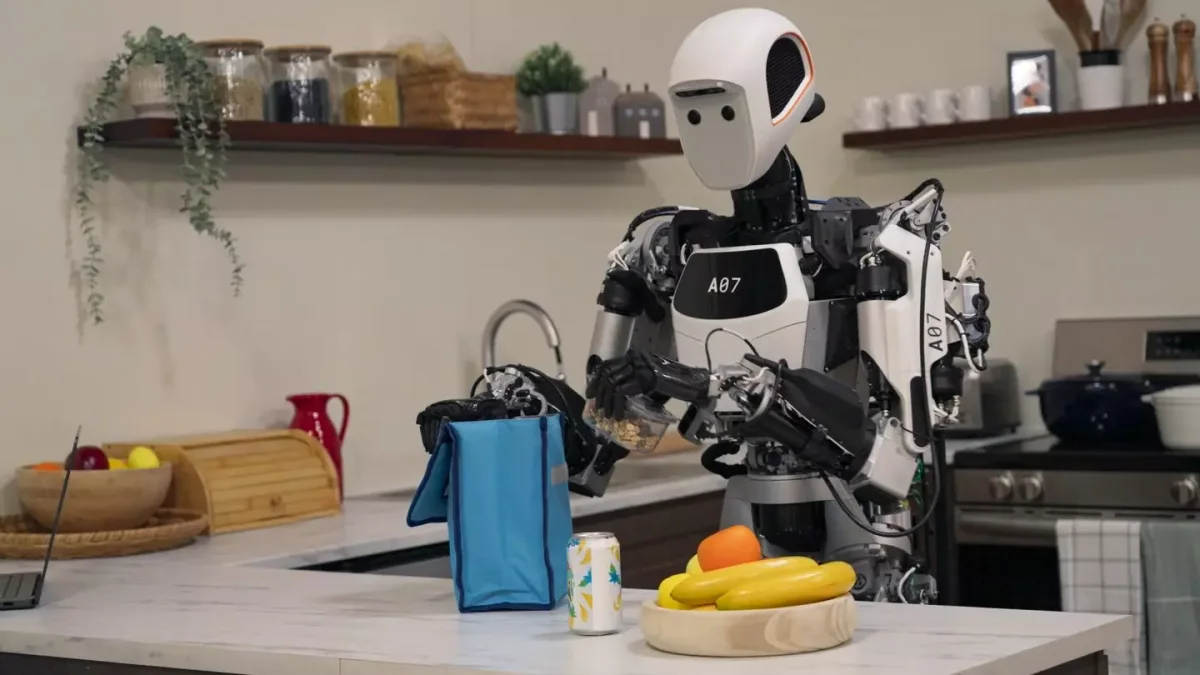
Google DeepMind has released a demonstration of its Apollo 2 humanoid robot, showcasing the machine's ability to coordinate fine motor skills to complete complex kitchen tasks. The video, posted on the company's official X account on Friday, July 31, 2026, highlights a significant step in robotic dexterity, a challenge that has long stymied the field. In the post, DeepMind noted that while humans often take dexterity for granted, asking an artificial intelligence model to coordinate such movements is extremely complex. The demonstration is the result of a collaboration between Google DeepMind and Apptronik, a robotics startup based in Austin, Texas. Apptronik first introduced its Apollo humanoid robot in early 2023.
In an interview with IEEE Spectrum in January 2023, Apptronik's founders, CEO Jeff Cardenas and CTO Nick Paine, expressed their belief that Apollo was the answer to the quest for a versatile humanoid robot. Apptronik has since developed Robot Park, a dedicated training facility for humanoid robots located in Austin. According to a report by the Manila Times on June 30, 2026, a fleet of Apollo 2 robots continuously collects real world data at various Robot Park locations and customer sites to develop AI models for future humanoid systems, working in partnership with Google DeepMind. In the latest demonstration, Apollo 2 was pushed to master fine motor skills and complete intricate kitchen tasks.
DeepMind did not specify the exact tasks performed, but the shared video shows the robot holding and manipulating small objects such as spoons, glasses, and food items, all of which require precise hand eye coordination. Robotic dexterity has been one of the biggest hurdles in humanoid robot development. Tasks that are simple for humans, such as pouring water into a glass or picking up a small object from a drawer, require extremely complex calculations of position, pressure, and balance for a robot. Google DeepMind stated that coordinating these movements is very difficult to ask of an AI model. The collaboration between Google DeepMind and Apptronik began at least as early as mid 2026.
Robot Park, described as a "school" for humanoid robots, allows thousands of Apollo 2 robots to train simultaneously in a controlled environment. The data collected from these training sessions is used to train more advanced AI models, which are then implemented back into the robots to improve performance. Apptronik was founded by alumni of the Human Centered Robotics Lab at the University of Texas at Austin. The company has attracted attention from investors and industry partners due to its modular approach and focus on real world applications, such as warehouse and manufacturing work. The Apollo robot is designed to be a versatile platform that can be programmed for a variety of tasks.
The success of Apollo 2 in mastering kitchen tasks indicates that the real world data driven training approach at Robot Park is beginning to yield results. By collecting data from thousands of robots operating in diverse environments, AI models can learn from a wider range of situations, thereby improving the robot's generalization capabilities. Google DeepMind, the AI division of Alphabet Inc., has long focused on developing AI that can interact with the physical world. Previously, DeepMind has developed AI models capable of playing games, predicting protein structures, and controlling robots in simulated environments. The Apollo 2 demonstration represents a concrete step toward applying AI to physical robots in the real world.
Despite the significant progress shown in this demonstration, major challenges remain before humanoid robots can operate autonomously in unstructured home or kitchen environments. Factors such as production costs, battery life, and the safety of human robot interaction still need to be addressed. However, the collaboration between Google DeepMind and Apptronik provides a clear path for continued improvement of robot capabilities. Apptronik has not yet announced a commercialization schedule for Apollo 2 for the consumer market. Currently, the company's primary focus is on industrial and logistics applications, where robots can work in more controlled settings. Nevertheless, the capabilities demonstrated in this kitchen showcase open up possibilities for future use in hospitals, restaurants, and private homes.
Google DeepMind and Apptronik have not provided further comment on the technical details of the AI models used or their future development plans. However, with Robot Park continuing to operate, the data collected will keep growing, enabling gradual enhancements in robot performance.