Technology
DGX Spark now runs DeepSeek V4 Flash 284B with a single install command
DGX Spark users can run DeepSeek V4 Flash 284B at 1,000 tokens per second prefill and 59 tokens per second multi-agent serving with one command.
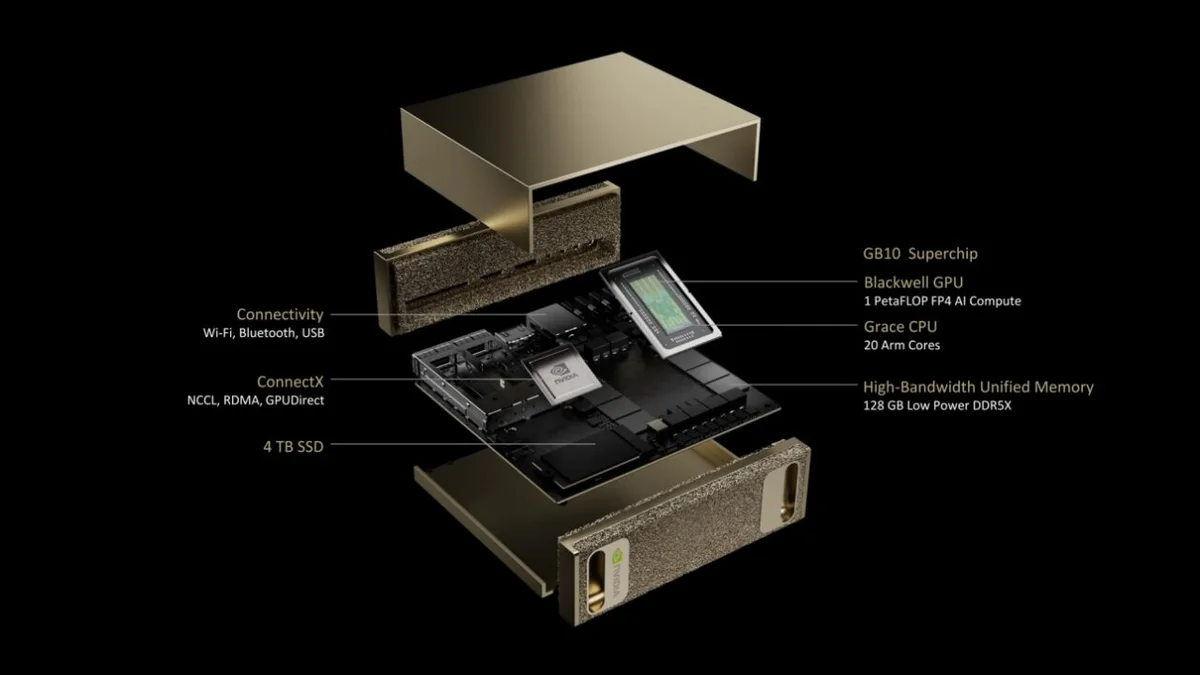
A post on X by Bleys Goodson (@bleysg) in early August 2026 suggests that owners or prospective buyers of the NVIDIA DGX Spark should take note of a new development. The post claims that the DeepSeek V4 Flash version 07 31, with 284 billion parameters, can now be served on a single DGX Spark unit at a prefill speed of 1,000 tokens per second and 59 tokens per second for multi agent serving scenarios. The installation process is said to require only a single command. This claim comes amid growing interest in running large AI models locally on desktop devices. NVIDIA markets the DGX Spark as an "AI supercomputer on your desk," designed to run autonomous AI agents directly from the user's desktop.
If the claim is accurate, it means a model with 284 billion parameters can operate fully without reliance on cloud infrastructure. The @bleysg post does not include full technical details about the hardware or software configuration used. However, discussions on the NVIDIA developer forum provide additional context. A thread dated June 29, 2026, reported that DSpark, a speculative decode build of DeepSeek V4 Flash, delivers real speed improvements on a two DGX Spark configuration with tensor parallelism (TP=2). In code generation tests, speeds reached 60 67 tokens per second, up from around 40 45 tokens per second on regular V4 Flash decode. Speculative decoding works by drafting several tokens per step, and the target model verifies them in a single pass.
When the draft acceptance rate is high, such as with predictable content like program code, the speed improvement is significant. On mixed or varied content, speeds drop to around 40 tokens per second. The thread also mentions the use of NVFP4 KV cache with the nvfp4 ds mla configuration. Another thread on the same forum, dated July 31, 2026, reported experiences running DeepSeek V4 Flash 0731 on two DGX Spark units. The user found that a small configuration change was needed to restore speculative decoding acceptance rates. Without that change, the model ran at 30 tokens per second, but after adjustment, speeds returned to normal as in the previous preview version. The user also noted that decode throughput was halved without a drop in output quality.
Meanwhile, a post on X by the account keys 🧪 (@u1tra instinct) mentioned a two DGX Spark configuration with 1 million context and a 2.6 million token pool at speeds of 60 70 tokens per second. This figure aligns with the NVIDIA forum reports of speed improvements on two device setups. On the other hand, an article on flowtivity.ai dated August 2, 2026, discussed DeepSeek V4 Flash 0731 on two DGX Spark units, focusing on the 13 billion active parameters. The article stated that this model delivers frontier level agentic performance at a size 10 times smaller than Claude Opus. They ran it with Hermes Agent for private on premises AI workloads at 41 tokens per second, and included a cost analysis and the economic implications of running AI agents locally.
The differing speed figures across sources indicate that performance depends heavily on specific configurations, content types, and software adjustments. The 59 tokens per second claimed by @bleysg for multi agent serving falls within the range reported by other sources, though the exact configuration is not detailed. The presence of technical recipes on GitHub, such as the tonyd2wild repository providing a guide to running DeepSeek V4 Flash on two DGX Spark nodes with vLLM, TP=2, FP8 KV, and MTP over RoCE/RDMA connections, shows that the user community has developed solutions to optimize these devices. The repository includes Docker images, launch scripts, and RDMA/NCCL settings. For users considering purchasing a DGX Spark, claims about running a 284 billion parameter model locally could potentially change cost calculations.
Instead of renting cloud computing capacity for large scale models, a desktop device with a more affordable price could become an alternative. However, it should be noted that most of the best performance reports come from two device configurations, not a single unit. NVIDIA itself has not issued an official statement regarding @bleysg's claim. The information currently circulating comes from users and community developers conducting their own tests. The verification status of @bleysg's post is recorded as a single source, with all claims attributed without additional detail. This development comes amid a broader trend toward distributed and private AI computing. The ability to run large models on local devices reduces the need to transfer data to the cloud, which is relevant for organizations with strict privacy requirements.
The flowtivity.ai article explicitly discusses the economic shift of running local AI agents for on premises workloads. For users who want to try it, the next steps are to monitor @bleysg's thread on X for further installation details, as well as the NVIDIA developer forum for configuration updates. The community is also continuously refining technical recipes available on GitHub, which can serve as a starting point for users looking to replicate reported results.