AI
Claude Model Fails to Crack Riemann Hypothesis but Makes Major Math Breakthrough
An unreleased Claude model raised the lower bound for the fraction of zeros of the Riemann zeta function from 41.6% to 67.2% in a 54-hour experiment.
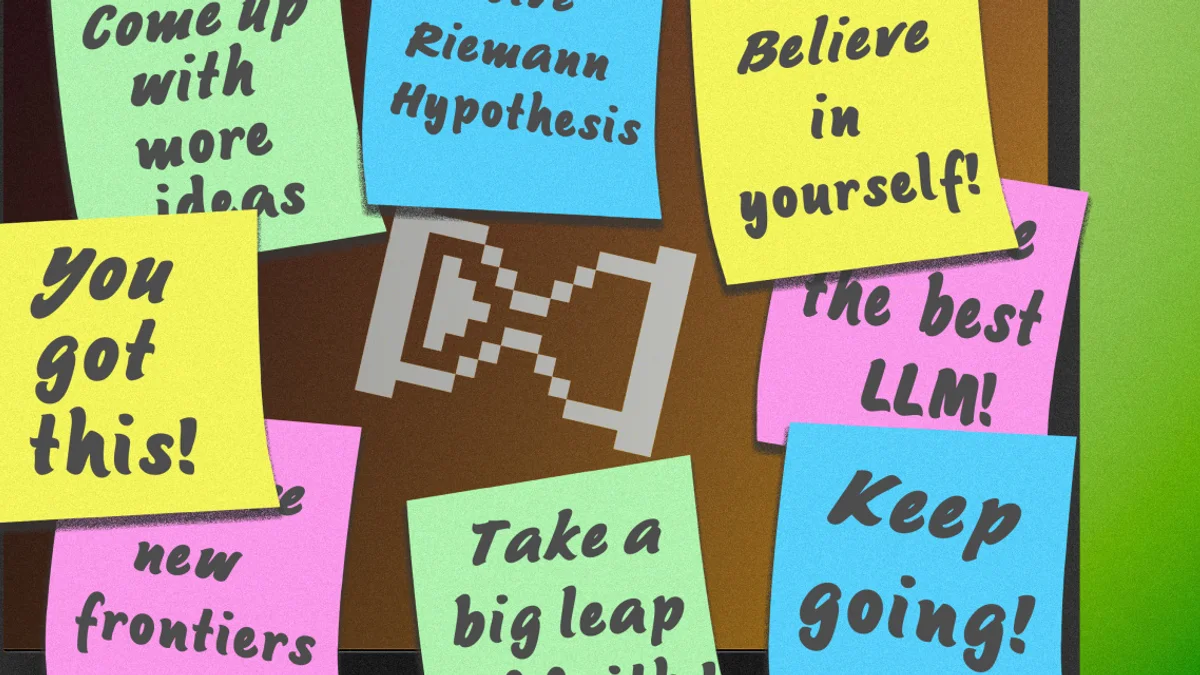
An unreleased artificial intelligence model from Anthropic has achieved a significant mathematical advance while attempting to solve the Riemann Hypothesis, one of the most famous problems in mathematics. According to a report by Ben Cohen in the Wall Street Journal, the Claude model improved the lower bound for the fraction of zeros of the Riemann zeta function that satisfy the hypothesis, from 41.6% to 67.2%. This achievement occurred during a 54 hour experiment that failed to fully solve the hypothesis but produced a breakthrough recognized by experts. The Riemann Hypothesis, first proposed in 1859, states that all non trivial zeros of the Riemann zeta function have a real part equal to 1/2.
It is one of the seven Millennium Problems announced by the Clay Mathematics Institute, with a prize of one million dollars for anyone who can prove or disprove it. For over a century, mathematicians have sought to prove the hypothesis, and every small advance in understanding the distribution of zeros of the zeta function is considered significant. According to research published by Anthropic, the unreleased Claude model successfully raised the lower bound from 41.6% to 67.2%. This figure refers to the proportion of zeros of the zeta function that are proven to lie on the critical line (real part = 1/2). Previously, this lower bound had been improved incrementally by mathematicians over several decades, and the jump from 41.6% to 67.2% represents a substantial increase.
The achievement was made through two sessions of Claude Code, involving 60 subagents, and produced 31 million tokens of output, as reported by ExplainX. The experiment began when a user repeatedly prompted the Claude model to attempt to solve the Riemann Hypothesis. According to the Wall Street Journal report, the model worked continuously for 54 hours, and although it did not succeed in proving the hypothesis outright, it discovered new evidence that raised the lower bound. Researchers at Anthropic then verified the results and published them as part of research on Claude's mathematical capabilities. The ability of AI to make such mathematical breakthroughs demonstrates its potential to accelerate scientific research.
AI models like Claude can explore vast solution spaces at speeds impossible for humans and can identify patterns or proofs that human researchers might overlook. However, the role of human prompting in this process is also crucial, as shown in this experiment. The user who persistently encouraged the model to try, despite initial failures, acted as a catalyst for the breakthrough. Anthropic, the company behind Claude, has long focused on developing safe and beneficial AI. Research into Claude's mathematical abilities is part of their effort to understand and improve the reasoning capabilities of their models.
In its official publication, Anthropic stated that the unreleased model showed significant progress in tackling complex mathematical problems, and the results provide insight into how AI can be used to solve difficult scientific problems. This breakthrough also has broader implications for the technology industry. The ability of AI to conduct advanced mathematical research could be applied in various fields, including cryptography, computer science, and theoretical physics. However, experts caution that much work remains before AI can fully replace human mathematicians. The Claude model, despite improving the lower bound, still cannot fully solve the Riemann Hypothesis, indicating that the most difficult mathematical problems still require human creativity and intuition. The improvement of the lower bound from 41.6% to 67.2% is not trivial.
For comparison, this lower bound has been improved gradually by mathematicians over many years, and a jump of this magnitude typically requires years of research. The fact that an AI model achieved this in 54 hours highlights the potential of AI to accelerate mathematical research. However, it is important to note that the model has not been released publicly, and the results still need to be verified by the mathematical community. According to the Wall Street Journal report, the Claude model worked in a manner similar to a human mathematician, trying various approaches and using logical reasoning. However, its speed and persistence far exceed human capabilities. During the 54 hours, the model explored many possibilities and eventually found evidence that raised the lower bound.
This process involved the use of subagents, which are AI instances that work in parallel to complete specific tasks. The success also highlights the importance of human AI interaction in scientific research. The prompting from the user, who kept encouraging the model to try, appears to have played a key role in keeping the model focused and motivated. This suggests that although AI is highly capable, human support and direction are still necessary to achieve optimal results. Researchers at Anthropic expressed surprise at the outcome and plan to continue exploring Claude's mathematical abilities further. Meanwhile, the mathematical community has welcomed the breakthrough, though with caution. Some experts have stated that the results need to be replicated and independently verified before they can be fully accepted.
If the results are valid, this would be one of the most significant advances in number theory in recent years. It would also provide strong evidence that AI can be used to solve mathematical problems that were previously considered too difficult for machines. Going forward, Anthropic plans to release more details about the model used in the experiment and the methodology employed. They also hope that these results will encourage more research into the use of AI in mathematics and science. With such capabilities, AI could become an invaluable tool for scientists and mathematicians, helping them solve problems that once seemed impossible. However, it is important to note that this breakthrough does not mean AI will soon replace human mathematicians.
The Riemann Hypothesis remains unsolved, and many other challenging mathematical problems persist. The Claude model, despite its intelligence, still has limitations. Nevertheless, this achievement demonstrates that AI can be a powerful partner in mathematical research, and with the right prompting, AI can accomplish remarkable things. Overall, this breakthrough is a concrete example of AI's potential to accelerate scientific discovery. With the ability to work tirelessly and explore vast solution spaces, AI can help humans solve even the most difficult problems. Although many challenges remain, the future of AI in mathematics and science looks very promising.